

Wed 28 October 2026
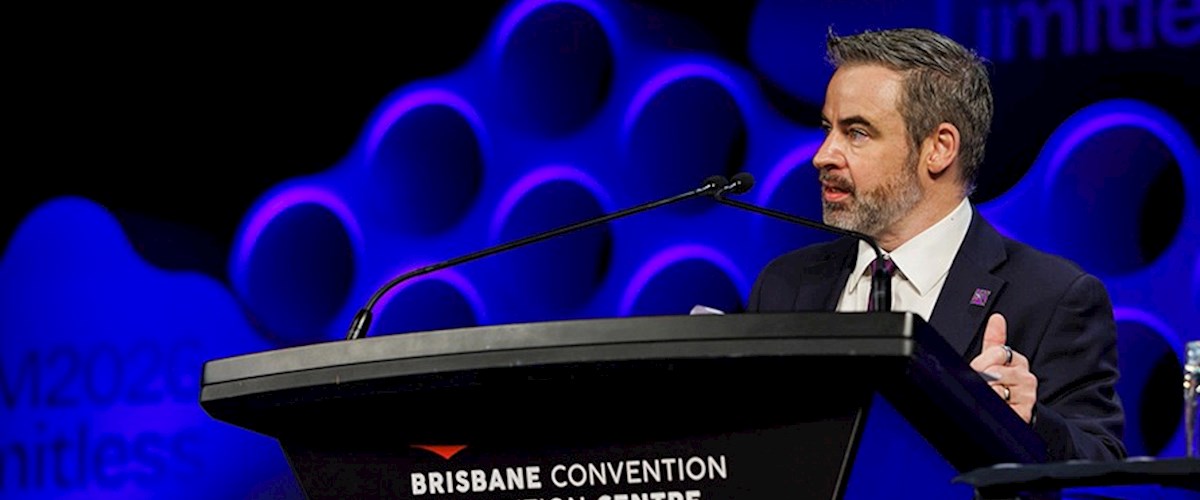
MM2026 President's Address
Well, what a year – with some way still to go. A year of accelerating change and increasing uncertainty.
With AI drowning our news feeds, strategic planning sessions and backyard barbecues, it may sound strange when I tell you that at MM2025 last year, there were six sessions with ‘AI’ in the title, but this year there is one.
But we know it will still be everywhere.
At this conference – which is the largest and most advanced of its kind in Australia – AI has shifted from the headlines. It’s now woven into the fabric of MM2026.
It is startling to consider how rapidly increasingly powerful and accessible AI tools have become embedded in all aspects of our lives.
Here, discussion and debate will centre on innovation, privacy and safety. Outside, there is a much more confronting narrative.
Very fair questions around data, security, accountability, influence and creativity prompt unsatisfactory answers.
Sharper questions around safety and guardrails, data centres and the environment, are already fomenting community outrage, here and around the world.
Regardless of how actively interested or invested, most of us share a general unease that technology is probably moving faster than we can steer it, and that the big decisions are being made somewhere else, by someone else.
At the same time, I know there is frustration and anger.
Far from a productivity boom, we are looking at a recessionary economic cycle.
So how can we prioritise health care right now, when everything is costing more, and AI is potentially a solution… but potentially yet another source of pressure?
The reality on the ground is we are all doing it tough.
I have spoken to many people in this room about the cyclical nature of public health and the subtle forces – mostly external and beyond our control – that coalesce to smash budgets and strain our resources.
It has happened before, but not like this.
The political climate is putting the engines of innovative healthcare in the firing line, which include: strong public investment, agency stewardship of health data, community trust and health literacy, and responsible migration.
In this febrile environment – whether AI prompts unease, or anger or apathy – I suggest our profession is actually better equipped to handle it than most.
It is the ultimate catalyst, and hospital pharmacy has always pushed the boundaries of practice scope and better ways of doing things.
We will see phenomenal new drugs entering the market at faster rates, and advanced pharmacy is built on managing powerful things safely.
We don't fear potent medicines. We don't avoid them, we govern them.
We schedule them, we write protocols, we build in independent checks, we monitor for harm, we report when something goes wrong, we learn from it and we advise and teach others.
These rigorous principles, respect for the power of a tool plus insistence on human oversight, is exactly what this moment calls for.
Used well, and through our responsible advocacy, AI will take on the work that eats our days: repetitive documentation, data wrangling, and endless searching across systems.
With every faster answer, and every minute given back to a busy pharmacist or technician, it’s easy to see how benefit can accumulate quickly.
At the same time, we will never lose sight of what cannot be automated or digitised.
Yesterday I asked some members: ‘what is the best work you’ve ever done, what did it look like?
The common thread: there is always a conversation, an exchange of emotion and a new shared understanding.
It is the patient who reveals what they really take, once we pull up a chair and stop looking at the screen.
It is the moment family members understand that stopping a medicine can be an act of care.
And it is the phone call to a doctor on the care team, in which years of mutual respect translate into a better plan.
These moments are always more than the transfer of information, relying on trust, judgement, and accountability.
And so we gather again, away from the digital noise and the attention economy, on a mission toward shared understanding.
Australia’s largest scientific pharmacy conference is built on trust, judgement, and accountability, just as it has been since 1961.
That humble board room in Adelaide was essentially the same as this huge gathering, 50 conferences later: a very human marketplace of ideas.
This is why AdPha exists, and why rigorous governance and safety standards matters.
In this vein it is my great pleasure to formally announce that the Australian Perioperative Medicines Guide will be released in February next year, funded by a three-year grant from the Department of Health through the QUDTP grants program.
This is Australia's first perioperative medicines resource, supporting safer medication management around surgery.
There are three components – the guide itself, educational resources and a co-designed consumer resource – and I want to thank our consortium partner CATAG, and Lisa Pulver in particular who I know is here somewhere, with whom AdPha secured this competitive grant.
These are just two examples of how good ideas and honest challenges need somewhere to surface, be discussed and tested, leading to shared positions and understanding.
That’s how conversations in these rooms inform a voice that governments and health services listen to.
So, over the next few days, please enjoy the presentations and conversations, both planned and incidental.
And remember that while technology will make us faster, it is each other that will make us better, and the care we deliver, safer.